


When people talk about artificial intelligence, they often use machine learning and deep learning interchangeably, but they are not the same. Machine learning is a broader field where algorithms learn from data to make predictions, while deep learning is a specialized subset that uses neural networks modeled after the human brain. Understanding this difference is key to grasping how modern AI systems work.
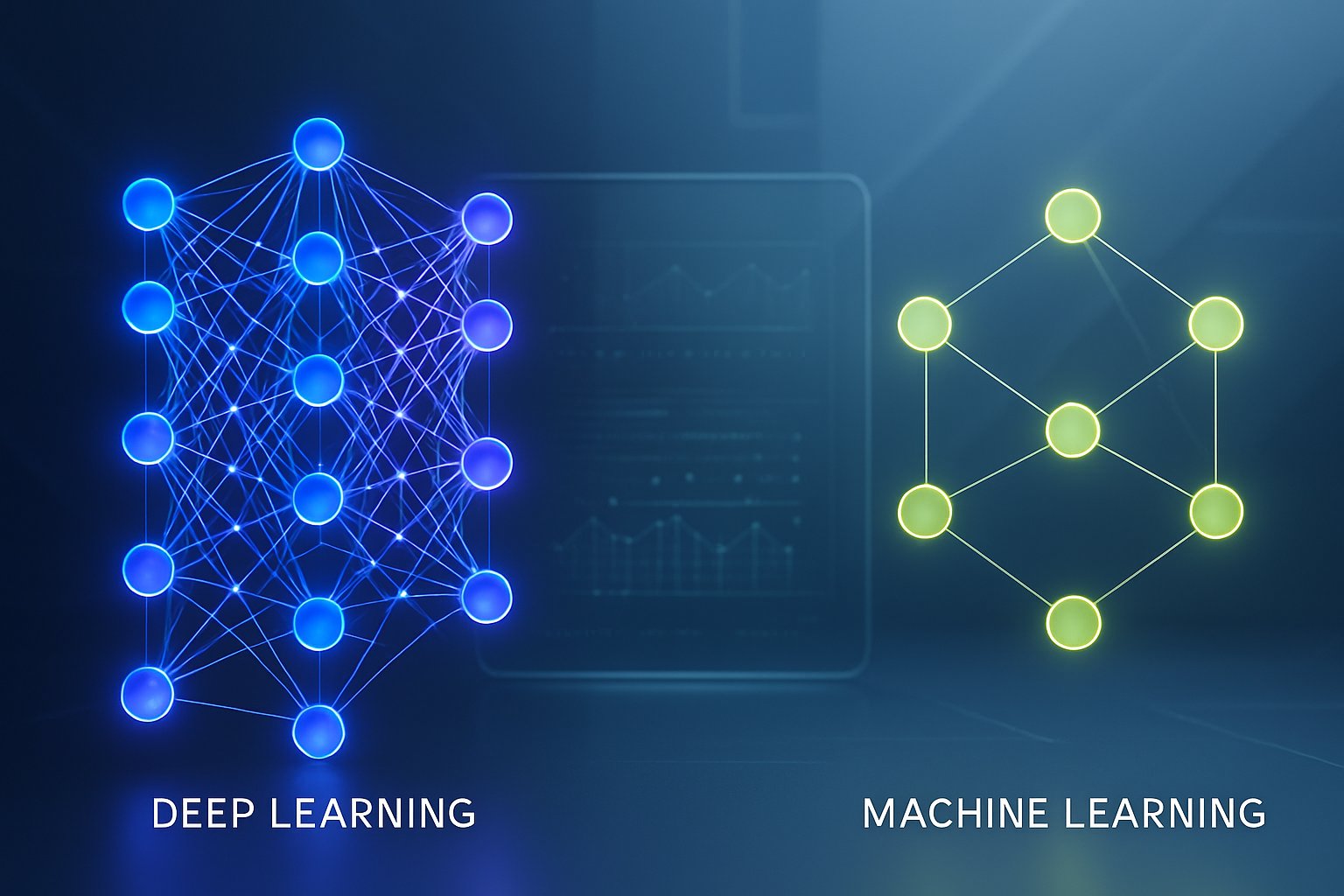
I find that deep learning requires much more data and computational power, often making it suitable for tasks like image recognition or natural language processing. Machine learning covers a wider range of techniques that can work well with less data, such as decision trees or support vector machines.
If you’re curious about when to use one over the other and how each impacts AI development, this post will clarify their distinct roles and applications. This knowledge is essential whether you’re exploring AI for business, research, or personal interest. For more detailed differences, see this explanation of deep learning vs. machine learning.
What is artificial intelligence (AI)?
Artificial intelligence involves designing systems that replicate aspects of human intelligence. These systems can analyze data, recognize patterns, and make decisions without explicit programming for every task.
The scope of AI covers various types and practical applications, especially in business. At its core, AI simulates human cognitive functions by using algorithms and data-driven models.
Categories of AI
AI is often divided into three main categories: narrow AI, general AI, and superintelligent AI.
Narrow AI focuses on specific tasks, like voice recognition or image classification. It operates under predefined rules and data.
General AI refers to machines with reasoning capabilities similar to humans, able to manage a broad range of activities.
Superintelligent AI goes beyond human intelligence, capable of outperforming humans in virtually all tasks. It remains theoretical at this stage.
Understanding these categories helps clarify AI’s current capabilities versus its potential future scope.
Using AI for business
Businesses use AI to automate processes, improve efficiency, and extract insights from large datasets. Common applications include customer service chatbots, fraud detection, and predictive analytics.
AI-driven automation can reduce operational costs and speed up workflows. Data analysis powered by AI uncovers trends that humans might miss.
Companies also leverage AI in personalized marketing and supply chain optimization. These applications are practical examples of AI’s impact on strategic decision-making.
What is AI?
AI simulates human intelligence using machines and software. It includes learning from data, reasoning, problem-solving, and adapting to new information.
At its base, AI mimics cognitive functions like perception and language understanding. It is an evolving field, with advancements extending the limits of machine capabilities.
AI isn’t a single technology but a collection of methods that enables computers to perform tasks that normally require human intelligence.
Was ist künstliche Intelligenz?
Künstliche Intelligenz (KI) ist die Simulation menschlicher Intelligenz durch Maschinen. KI-Systeme können lernen, Schlussfolgerungen ziehen und Entscheidungen treffen.
Es umfasst verschiedene Technologien wie maschinelles Lernen und tiefes Lernen. KI wird in vielen Bereichen angewendet, von der Medizin bis zur Automatisierung.
Die Fähigkeit von KI, große Datenmengen zu verarbeiten und Muster zu erkennen, macht sie zu einer wertvollen Technologie für viele Branchen weltweit.
What is machine learning?

Machine learning involves creating algorithms that allow computers to identify patterns in data and improve their performance over time without explicit programming. It is a fundamental component of artificial intelligence, often used to make decisions, predictions, or classifications based on data inputs.
Types of Machine Learning
I recognize three main types of machine learning: supervised, unsupervised, and reinforcement learning.
- Supervised learning uses labeled data, meaning the input is paired with the correct output. The model learns to predict outcomes based on this.
- Unsupervised learning works with unlabeled data, helping find hidden structures or patterns without a known outcome.
- Reinforcement learning involves training an agent to make decisions by rewarding desired behaviors and penalizing undesired ones.
Each type suits different applications. For example, supervised learning is common in spam detection, while reinforcement learning is used in game-playing AI.
Was ist maschinelles Lernen?
Maschinelles Lernen ist der deutsche Begriff für machine learning. Es bezeichnet die Fähigkeit von Computern, aus Daten zu lernen und Muster zu erkennen, ohne explizit programmiert zu sein.
Es umfasst dieselben Arten und Methoden wie im Englischen, einschließlich überwachtem, unüberwachtem und bestärkendem Lernen. Maschinelles Lernen wird in Deutschland sowohl in Forschung als auch Industrie eingesetzt, etwa bei der Betrugserkennung und der Automatisierung von Prozessen.
Do data analysts use machine learning?
Data analysts often integrate machine learning into their toolkit to enhance data insights. I find that analysts use machine learning primarily for predictive modeling, clustering, and anomaly detection.
Machine learning enables automation of repetitive tasks like sorting and classifying data. It can also help analysts uncover patterns not evident through traditional statistics, improving decision-making processes in business intelligence and operational efficiency.
What is deep learning?

Deep learning is a specialized branch of machine learning that uses complex structures to analyze data. It mimics the way the human brain processes information through multiple layers. These layers help computers recognize patterns, classify data, and make decisions without explicit programming at each step.
I’ll explain the core types of deep learning models, offer a clear summary of deep learning in German for multilingual understanding, and highlight how deep learning differs fundamentally from machine learning.
Types of Deep Learning
Deep learning relies mainly on neural networks with many layers, often called deep neural networks. The most common types include:
- Convolutional Neural Networks (CNNs): Used mostly in image and video recognition. They apply filters to detect features in visual data.
- Recurrent Neural Networks (RNNs): Ideal for sequential data such as text and time series, since they retain information across steps.
- Autoencoders: Used for data compression and noise reduction.
- Generative Adversarial Networks (GANs): These create new data by pitting two networks against each other.
Each type excels at particular tasks, depending on the structure and function of its layers.
Was ist Deep Learning?
Deep Learning ist ein Teilbereich des maschinellen Lernens, der darauf spezialisiert ist, komplexe Muster in großen Datenmengen zu erkennen. Dabei werden künstliche neuronale Netze verwendet, die aus mehreren, hierarchisch angeordneten Schichten bestehen.
Diese Schichten verarbeiten Informationen ähnlich wie das menschliche Gehirn, indem sie Merkmale extrahieren und verfeinern. Deep Learning ermöglicht automatisches Lernen aus unstrukturierten Daten wie Bildern, Texten oder Audiodateien.
Es wird häufig in Bereichen wie Spracherkennung, Bildverarbeitung und autonomem Fahren eingesetzt, weil es ohne manuelles Feature Engineering auskommt.
How deep learning differs from machine learning
Deep learning differs from traditional machine learning mainly in complexity and data handling. Machine learning typically uses algorithms that require manual feature extraction from data. Deep learning automates feature extraction through multiple layers of neural networks.
This makes deep learning more scalable for large datasets and capable of interpreting unstructured data like images, sound, and text. However, it demands more computational power and larger datasets to train effectively.
I see deep learning as a more advanced, resource-intensive subset of machine learning designed to solve complex problems that traditional algorithms may struggle with. For a deeper comparison, see this guide on deep learning vs machine learning.
How deep learning differs from machine learning

Deep learning builds on the foundations of machine learning but uses specialized structures to handle complex data. The key distinction lies in how models process information and learn patterns, with deep learning emphasizing multiple layers of transformation.
What is a neural network?
A neural network is a computational model inspired by the human brain’s network of neurons. It consists of layers: an input layer, one or more hidden layers, and an output layer.
Each layer contains nodes (or neurons) that process input data, apply weights, and pass the information forward through activation functions. Neural networks learn by adjusting these weights during training to minimize errors.
This structure allows neural networks to identify intricate patterns in data, making them suitable for tasks like image recognition or language processing. Unlike traditional algorithms, neural networks can generalize from examples instead of relying on explicit programming.
Was ist ein neuronales Netz?
Ein neuronales Netz ist ein Modell des maschinellen Lernens, das von biologischen Gehirnzellen inspiriert ist. Es besteht aus mehreren Schichten, die miteinander verbunden sind, darunter Eingabe-, verborgene und Ausgabeschichten.
Jede Schicht enthält Knoten, die Daten empfangen, gewichten und durch Aktivierungsfunktionen weiterleiten. Während des Trainings passen neuronale Netze ihre Gewichtungen an, um die Genauigkeit zu verbessern.
Diese Architektur ermöglicht das Erkennen komplexer Muster in großen Datensätzen, z. B. bei Bilderkennung oder Sprachverarbeitung. Ein neuronales Netz lernt also eigenständig und benötigt keine explizite Programmierung für jede Aufgabe.
What’s the difference between deep learning and neural networks?
Deep learning is a subset of machine learning that specifically uses deep neural networks—networks with many hidden layers. The term “deep” refers to these multiple layers.
A neural network can be shallow, with only one or two layers, or deep, with dozens or more. Deep learning relies on complex architectures to automatically extract features from raw data without manual intervention.
This allows deep learning models to outperform traditional machine learning models on tasks involving large, unstructured datasets like images, audio, and text. Essentially, every deep learning model is a neural network, but not every neural network is deep learning.
For more detailed distinctions, see how deep learning and machine learning differ in their architectures and applications at Deep Learning vs Machine Learning: Key Differences Explained.
Applications and future of deep learning and machine learning
Both deep learning and machine learning are changing industries by automating complex tasks and providing new insights from data. They enable advancements in areas like healthcare diagnostics, financial forecasting, and real-time decision-making.
The different fields of application
I see machine learning widely used in applications that involve structured data, such as credit scoring, fraud detection, and recommendation systems. It excels in tasks where algorithms learn patterns from historical data to predict outcomes or classify information.
Deep learning, on the other hand, is preferred for unstructured data like images, audio, and text. It powers technologies such as voice assistants, facial recognition, and autonomous vehicles. Its layered neural networks allow it to identify complex features without manual intervention.
A simple comparison of both:
| Application Area | Machine Learning | Deep Learning |
|---|---|---|
| Data Type | Structured data | Unstructured data (images, speech, text) |
| Use Cases | Fraud detection, spam filtering | Image recognition, speech analysis |
| Complexity Handling | Moderate | High, captures intricate patterns |
Future of Machine Learning and Deep Learning
I expect both fields to grow rapidly, especially with advances in computational power and data availability. Machine learning will continue optimizing business processes and personalization through improved algorithms and automation.
Deep learning is moving toward more generalized AI capabilities, enabling machines to reason and adapt across tasks. This progress supports innovations in healthcare diagnostics, autonomous systems, and natural language understanding.
Efforts toward Artificial General Intelligence (AGI) suggest future AI systems could perform diverse cognitive functions closer to human intelligence, a shift fueled by advances in deep learning architectures and training methods.
Wie wirken sich maschinelles Lernen und Deep Learning auf den Kundenservice aus?
Machine learning improves customer service by enabling chatbots and recommendation engines to provide timely and personalized responses. I notice it helps reduce wait times and route queries efficiently, increasing customer satisfaction.
Deep learning enhances these capabilities by understanding the context and sentiment behind customer interactions. For example, it can analyze voice calls or written messages to detect emotions and urgency, allowing for better prioritization.
Together, they enable predictive support — anticipating customer needs based on prior behavior patterns — and automate routine tasks, letting human agents focus on complex issues. This results in faster, more accurate, and more empathetic service experiences.
For more on these impacts, visit Future of Machine Learning and Deep Learning.
Build your machine and deep learning skills today
Starting with clear, focused steps can speed up your progress in mastering machine learning and deep learning. Identifying key areas to develop ensures efficient use of your time and resources.
Become an AI expert
To become proficient in AI, I concentrate on mastering foundational concepts first. Understanding algorithms like decision trees, support vector machines, and neural networks is crucial. I spend significant time writing code for projects to reinforce theory with practical experience.
Consistency matters. I dedicate regular hours to studying math topics such as linear algebra, probability, and statistics because they underpin algorithm functions. I also stay updated by following recent research and implementing new models.
Creating a portfolio with real-world problems, using datasets from sources like Kaggle, demonstrates my skills to potential employers. This focused approach accelerates skill acquisition and prepares me for complex challenges in AI.
Coursera Staff
Learning from experienced instructors provides reliable guidance. Coursera offers structured courses created by AI experts that cover both theory and application step by step.
I find that their courses blend video lectures, quizzes, and hands-on projects effectively. This mix helps me grasp difficult concepts without feeling overwhelmed. Many courses also provide access to code notebooks and community forums for support.
Their modular design lets me start from beginner to advanced levels at my own pace. It’s a practical way to build skills systematically, with recognized certificates proving my competencies in machine learning and deep learning.
For those serious about growing in AI fields, Coursera is a resource I recommend for quality and flexibility.
Discover more about these topics through the Deep Learning vs. Machine Learning: A Beginner’s Guide.
Frequently asked questions (FAQ)
Many aspects of machine learning and deep learning depend on time commitment, technical skills, career potential, and specific applications like natural language processing. Understanding these points helps clarify what’s involved in learning and working with these technologies.
How quickly can I learn machine learning?
The speed at which you learn machine learning depends on your background in math, programming, and data analysis. If you already know Python and basic statistics, you can grasp core concepts within a few months by dedicating consistent study time.
Focused learning on algorithms, model evaluation, and hands-on projects accelerates your progress. Online courses often provide structured paths with practice problems. However, mastering advanced topics and real-world application takes longer, typically a year or more.
I recommend starting with fundamentals such as supervised learning and gradually moving to more complex algorithms to build a solid base.
How tough is deep learning?
Deep learning is more complex than traditional machine learning because it involves designing, training, and tuning deep neural networks. These networks require understanding of multiple layers, backpropagation, and large amounts of data.
The computational demand is higher, often needing GPUs to train models effectively. For beginners, the math behind it—mainly linear algebra and calculus—can be challenging but manageable with dedicated effort.
While the concepts are more advanced, there are many frameworks like TensorFlow and PyTorch that simplify implementation, making deep learning more accessible.
Does deep learning require coding?
Yes, coding is essential in deep learning. You need to write code to build, train, and test neural networks. Python is the most common language used due to its rich ecosystem.
Libraries such as TensorFlow, PyTorch, and Keras provide pre-built functions that reduce coding complexity but still require programming knowledge. Understanding code helps with customizing models and debugging.
Non-coding tools exist but are limited for serious deep learning projects. To succeed and innovate in deep learning, I advise gaining solid programming skills.
Is machine learning a good career?
Machine learning is a strong career choice with growing demand across industries like healthcare, finance, and automotive. The need for professionals who can develop and implement ML models remains high.
Roles vary from data scientists and ML engineers to research scientists. Salaries tend to be competitive, reflecting specialized skills and technical expertise.
To build a career, focus on strong foundations in algorithms, programming, and data handling. Real-world project experience greatly improves job prospects.
What is natural language processing (NLP)?
Natural Language Processing (NLP) is a branch of AI focused on enabling machines to understand, interpret, and generate human language. It powers applications like chatbots, translation tools, and voice assistants.
NLP combines linguistics and machine learning techniques to analyze text and speech data. Deep learning has advanced NLP through models like transformers, improving tasks such as sentiment analysis and language generation.
Understanding NLP requires familiarity with text preprocessing, models, and evaluation metrics. It’s a key area that bridges human communication and machine intelligence.
Learn more about the differences between deep learning and machine learning in detail here.









Leave a Reply